Choosing reliable China Top Plastic Base Shower Drains Manufacturers requires more than comparing prices. Product performance depends on material quality, mold accuracy, drainage design, and consistent factory control. Plastic Base Shower Drains should resist moisture, household cleaners, temperature changes, and daily impact. A dependable manufacturer can explain these details clearly.
Experienced suppliers usually provide practical options for different bathroom layouts. These may include adjustable heights, removable grates, odor-control features, and compatible outlet sizes. Inspect the plastic finish closely. It should appear even, without rough edges, warping, or visible stress marks. Ask for dimensional drawings, material specifications, sample testing, and production photographs. Small details matter.
Installation conditions also deserve attention. A drain that fits poorly can create standing water near the tile edge. That problem may appear weeks later. Reliable manufacturers should discuss slope requirements, sealing methods, packaging protection, and quality inspection procedures. Certifications and test reports can support confidence, but documents alone do not prove long-term performance. Factory communication and after-sales support remain important.
No supplier is perfect. That matters.
A thoughtful comparison should include response time, sample consistency, customization ability, and delivery records. Buyers should avoid judging a factory from attractive catalog images alone. When possible, review several samples and confirm measurements before placing a larger order. This approach helps importers, contractors, and bathroom brands select Plastic Base Shower Drains with greater confidence. The best supplier is not always the cheapest. It is the one that combines honest communication, stable production, and practical product knowledge.
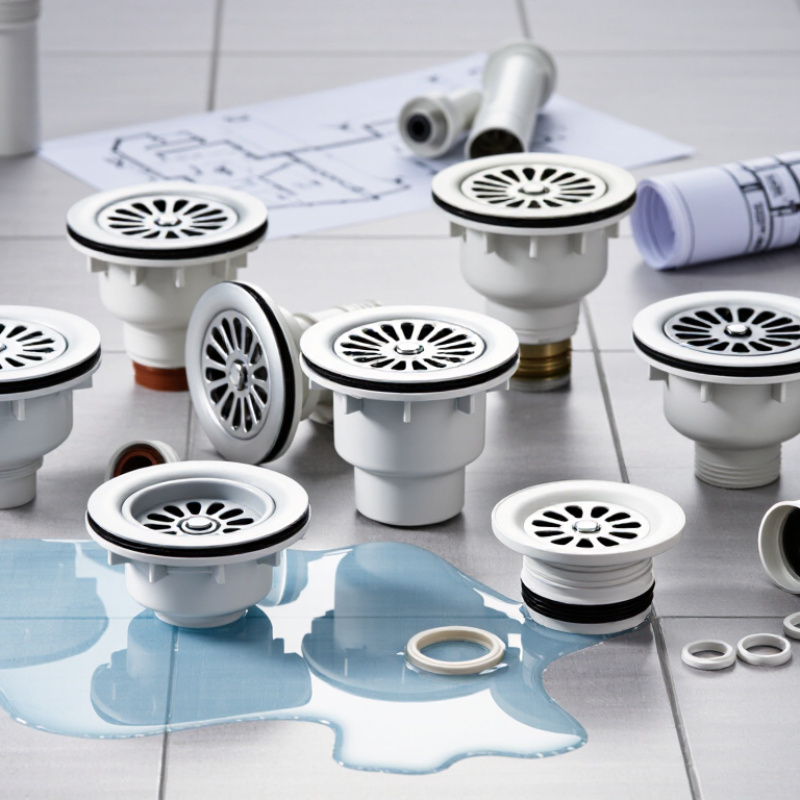
Plastic shower drains are simple components, yet failures often begin with material mismatch. PP resists many household chemicals and handles repeated temperature changes well. ABS offers strong impact resistance and is easy to mold, but prolonged heat exposure requires attention. PVC remains useful where rigid piping and solvent-welded connections are standard. Material choice matters.
DN50 is common in residential showers, especially where floor depth and flow demands are moderate. DN75 provides greater capacity for larger wet rooms, multiple outlets, or areas prone to hair buildup. Diameter alone does not guarantee drainage performance. A shallow trap, poor slope, or undersized outlet can slow water, even with DN75. I have seen this overlooked on rushed projects. Fit matters.
Reliable manufacturers should verify wall thickness, grate loading, seal compression, and dimensional consistency across batches. The drain should sit level, maintain a waterproof connection, and remain accessible for cleaning. Installers should confirm the actual pipe standard before ordering, since nominal sizes can mislead. Small tolerances become obvious when the grate rocks or the gasket folds. Testing with clean water helps, but it cannot replace long-term site observation. That limitation deserves honesty. Procurement teams should request material data, flow-test records, and inspection procedures instead of trusting polished product photos.
| Material / Size | Typical Material Characteristics | Typical Temperature Capability | Common Shower Drain Applications | Key Design Considerations |
|---|---|---|---|---|
| PP plastic drain | Lightweight, tough, moisture-resistant, and generally resistant to many household chemicals. PP has good fatigue resistance and is suitable for molded drain bodies and removable components. | Common plumbing-grade PP products are typically used for continuous drainage service around 60–80°C, with short-term limits determined by the specific formulation and design. | Residential bathrooms, wet rooms, prefabricated shower units, and installations where low weight and chemical resistance are important. | Allow for thermal expansion, verify gasket compatibility, and select a product with adequate reinforcement around the grate, outlet, and waterproofing flange. |
| ABS plastic drain | Rigid, impact-resistant, and easy to process. ABS is widely used for drainage components because it provides good dimensional stability and practical mechanical strength. | Usually selected for normal cold- and warm-water drainage. Continuous service is commonly kept below approximately 60°C unless the product specification states otherwise. | General residential showers, renovation projects, modular bathroom systems, and applications requiring a rigid molded drain body. | Protect from prolonged direct sunlight unless UV-stabilized, and use the solvent, seal, or mechanical jointing method specified for the drainage system. |
| PVC / PVC-U drain | Rigid, dimensionally stable, corrosion-resistant, and commonly available in standardized drainage pipe systems. PVC-U is unplasticized PVC used for rigid plumbing products. | Typical drainage service is intended for ambient and warm wastewater; many PVC-U systems are limited to approximately 60°C continuous discharge, subject to the applicable standard. | Fixed residential and commercial shower floors, tiled wet rooms, and systems connected to rigid PVC waste piping. | Confirm compatibility between drain outlet, pipe outside diameter, solvent cement, rubber seals, and the waterproofing membrane system. |
| DN50 outlet | Nominal drainage size of 50 mm. The actual pipe outside diameter, socket dimensions, and connection profile vary according to the regional piping standard and fitting design. | Suitable for many individual residential showers when the connected pipework and hydraulic design are correctly sized. | Compact shower trays, standard bathroom showers, apartment bathrooms, and installations with moderate discharge demand. | Check the trap seal depth, available floor void, pipe gradient, grate opening, and local plumbing requirements before selection. |
| DN75 outlet | Nominal drainage size of 75 mm. It provides a larger flow path than DN50, although actual capacity depends on the grate, trap, pipe slope, pipe roughness, and installation configuration. | Appropriate for drainage layouts designed for higher discharge or longer pipe runs, subject to the selected system’s temperature rating. | Large-format showers, multi-head shower areas, commercial washrooms, accessible wet rooms, and projects requiring greater drainage allowance. | Verify floor space, waterproofing flange dimensions, trap availability, maintenance access, and compatibility with the building drainage system. |
| PP / ABS / PVC grate and cover options | Plastic grates are corrosion-resistant and lightweight. Load performance varies significantly with rib geometry, support structure, material grade, and installation quality. | Use only within the temperature range stated for the complete drain assembly, including seals, coating, and connection parts. | Domestic floor-level showers, prefabricated bases, tiled drains, and low-corrosion indoor wet areas. | Select the grate load class for the intended location; do not use a pedestrian shower grate in vehicle, industrial, or heavy-equipment areas. |
PP handles many household chemicals and repeated temperature changes well. ABS resists impact but needs care near prolonged heat. PVC suits rigid piping and solvent-welded connections. Material choice still depends on the installation environment.
DN50 suits many residential showers with moderate flow and limited floor depth. DN75 offers more capacity for larger wet rooms or multiple outlets. A larger diameter cannot fix poor slope or a shallow trap. Size is not everything.
No. Drainage also depends on outlet size, pipe slope, trap depth, and grate condition. Hair and soap can reduce flow quickly. I have seen larger drains perform poorly on rushed installations.
Confirm the actual pipe standard, not only the nominal diameter. Check floor depth, outlet position, gasket size, and flange height. Small differences matter. A folded gasket can cause leakage.
Inspect the drain body, gasket, threaded connection, and pipe joint. Hold clean water around the flange for a measured period. Record rejected units and test duration. A quick visual check is not enough.
Request material data, sample measurements, flow-test records, and inspection procedures. Ask about wall thickness and dimensional consistency across batches. Production capacity should be verified, not assumed. Photos prove very little.
Use a fixed water head, a clean grate, and a calibrated collection container. Record drainage in liters per minute. Test again with hair and soap conditions when possible. Showroom results can be optimistic.
A stable water trap, hygienic surface, or properly designed membrane can block sewer gases. Very shallow traps may dry in unused bathrooms. Dry membranes can help, but debris may restrict movement. Laboratory results never copy every home perfectly.
Plastic Base Shower Drains are practical drainage solutions for residential, commercial, and industrial bathroom projects. Common materials include PP, ABS, and PVC, while DN50 and DN75 sizes support different installation and flow requirements. Leading manufacturers typically offer OEM services, precision injection molding, customized designs, and large-scale export capabilities. Buyers should evaluate production consistency, tooling expertise, packaging standards, and delivery experience when selecting a supplier.
Product quality should be assessed against relevant requirements such as EN 1253 and GB/T 27710, including 50 mm water-seal performance and appropriate load testing. Key comparisons should cover flow rate, leak resistance, corrosion resistance, durability, and odor control. Before placing an order, purchasers should review certifications, MOQ policies, tooling ownership, quality-control records, inspection procedures, material specifications, and lead times. A detailed audit can help confirm reliable performance, stable production, and long-term value.

 Xianglong